
Grimsby has always been a town that knows what it means to get on with it.
When I sat down with Katrina Goodhand, one thing came through clearly, again and again.
If you want mental health support and policy to work in the real world, it has to be shaped by the people who live with it.
Katrina is a Project Manager for Mental Health within the North East Lincolnshire Health and Care Partnership, working to implement the area’s all-age Mental Health Strategy. That strategy covers 2023–2028 and, importantly, it was co-produced with people who have lived experience of mental ill health.
This blog is about what that actually looked like, what has changed because of it, and what support is being strengthened across our community as a result.
A strategy written by people who know what it feels like
Katrina described the strategy work as starting with a blank sheet of paper, not a document written behind closed doors and then “consulted on”.
A group of people with lived experience took the data, held listening events, pulled in insight from public health, and worked through priorities line by line, asking one simple question: What would make mental health support better for people, next time they need it?
The group included people with a wide range of experiences, including bipolar disorder, eating disorders, and psychosis, alongside people living with long-term conditions that shape mental wellbeing too. What mattered most in Katrina’s telling was that nobody in the room was trying to protect a department, a budget line, or a reputation.
They were thinking about the person asking for help.
That difference changes everything.
How do you get people in the room, when life is already hard?
One of the most practical parts of Katrina’s story was how the listening began.
She did not rely on posters, leaflets, or generic outreach. Instead, she went through trusted VCSE organisations already working with people living with serious mental illness. The invitation did not come as “please come and give feedback”. It came as:
- Your voice matters.
- This will not be tokenistic.
- You are being invited as a spokesperson for your community.
That trust-first approach is one of the reasons this work has landed the way it has.
And when people did come together, the first step was not forced positivity. Katrina made space for what she called “pouring it out”, letting people name what had gone wrong, then moving into the more constructive question:
What should have happened instead, and how do we make that normal for the next person?
What people said they needed most
Katrina’s point was not that everything could be fixed overnight, but that people were far more realistic than some professionals expected. They did not ask for fantasy solutions. They asked for basic human things that make care feel safer and more joined up.
1) Better communication
Not just communication with someone using services, but communication between organisations too, so people are not repeating their story and diagnosis over and over.
2) Prevention, in the real sense
Not “preventing mental ill health” as if life does not happen, but preventing someone moving from care to crisis. That means early support, practical pathways, and not leaving people isolated while they wait.
3) Not being left on your own
This one really stayed with me. People understood waiting lists exist, but they did not want silence.
Katrina described how keeping in touch, checking in, and connecting people to trusted voluntary support while they wait can make a meaningful difference. It is not a replacement for clinical support, but it can stop someone feeling abandoned.
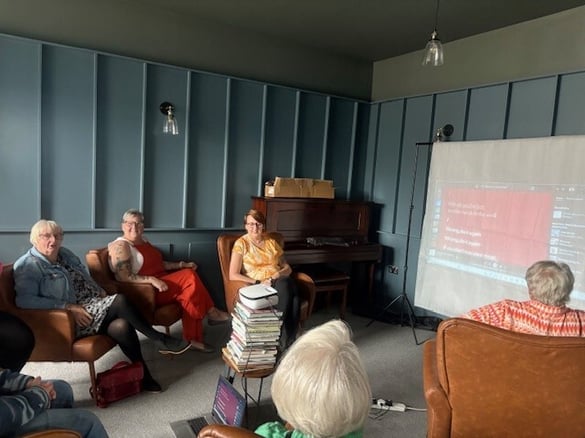
“Experts by experience” and “experts by training” need the same seat at the table
Katrina used language I think is helpful for all of us.
Professionals are experts by training. People with lived experience are experts by experience.
Co-production is not “asking for opinions” and then walking away to make the real decision. It is shared power at the table. The person with lived experience is not there to decorate the process. They have an equal vote.
Katrina shared a moment in a meeting about gym access for people with serious mental illness, where professionals started listing assumptions. Then two women with lived experience explained what it actually feels like, in your body and in your head, to walk into a mirrored space while living with medication effects, anxiety, or disordered eating.
The room went quiet, because lived experience has a way of cutting through theory.
And Katrina’s point was simple: there are things no dataset will ever tell you, if you do not listen to the people living it.
Designing support that feels human, not intimidating
One detail I loved was how the original group designed the listening event itself by starting with the question:
“What is the worst event you have ever been to?”
No toilets. No food. Everyone in suits and lanyards. PowerPoint. Being asked to approve something already decided.
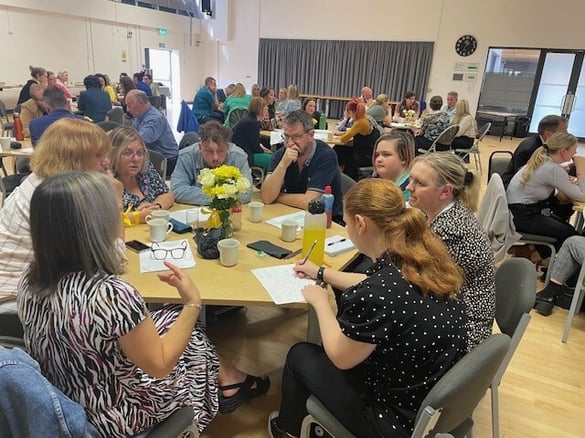
So they designed the opposite. No titles. No lanyards. No reserved seats. No PowerPoint. A warm, welcoming environment. And a room full of “keynote listeners”, including senior leaders, there to listen first.
Then they did something that people still talk about.
The ribbons
They used ribbons tied to chairs to show the scale of mental ill health, including the reality that, in a room of that size, many people will be affected at some point in their lives. People stood up, and the room could suddenly see what is usually hidden.
Katrina said other places have since copied it. That tells you something about how powerful simple, thoughtful design can be.
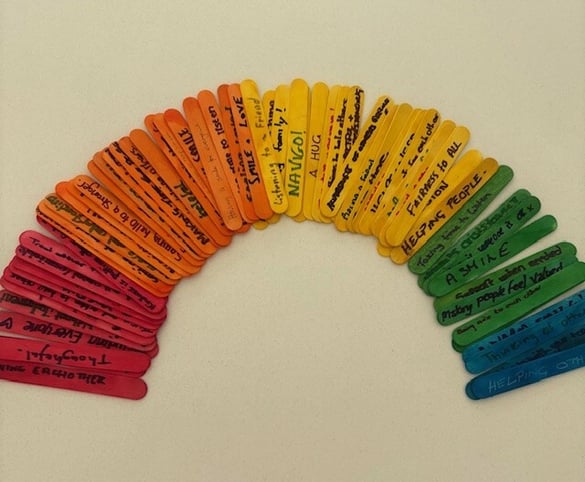
A culture of kindness, made practical
One of the priorities in the strategy is a culture of kindness.
Katrina was honest: you cannot “make” people kind. But you can define what kindness looks like in practice, recognise it, and build environments and policies that support it rather than squeeze it out.
From this came an employers’ self-assessment, created with people with lived experience, looking at things like:
- Is the environment welcoming, or does it feel like a barrier?
- Are people greeted properly, with eye contact and basic warmth?
- What happens if someone says they are struggling, what does the policy actually do?
- Do leaders model kindness from the top?
This is the kind of work that sounds small until you remember how much a single interaction can shape whether someone ever asks for help again.
The ripple effects: confidence, work, and people rebuilding their lives
Katrina shared an unexpected impact that made me smile.
Of the original group involved in the strategy, many went on to paid work. That was not the goal at the start, but confidence grows when people are treated as equal, listened to properly, and shown that their voice is genuinely useful.
One person returned to nursing after stepping away because of mental ill health. Another, who previously kept herself “head down and invisible”, went backpacking around Australia on her own.
These are not tidy “transformation stories”. They are real lives, moving forward, because someone finally treated experience as expertise.
A practical piece of support that could make a big difference: the Health and Care Passport
Another development Katrina spoke about is the Health and Care Passport, being tested and refined with people with lived experience including learning disabilities, autism and dementia. The purpose is straightforward: to help people communicate what matters to them in health and care settings, so they are not repeatedly explaining needs, preferences, triggers, and supports from scratch.
The point Katrina made was important: it is being built in a way that works for people now, not waiting for the “perfect” digital system to arrive someday. The future might be digital, possibly linked into existing NHS systems, but the content must remain community-written, because that is what makes it usable.
Suicide prevention and the “hand in hand” work: listening to the people at the sharp end
Right at the end of our conversation, Katrina spoke about current work connected to suicide prevention, and the need to listen to people earlier in the story, not just the statistics at the end.
One of her first steps was speaking to call handlers who are taking difficult, sometimes heartbreaking calls. Katrina described the emotional load they carry home, and how no dataset will show you that.
As a result, she brought together senior leaders across organisations to fund Samaritans training for call handlers, so that staff feel more supported in responding to those moments and looking after themselves too.
That is what this whole approach looks like in practice: listening properly, seeing what is missing, and then making something happen.
Katrina’s message, and why it matters
I asked Katrina what she would want people to take from this work, and her answer was clear:
If you listen to people who are living with something, you cannot be wrong.
Data matters. Budgets matter. Capacity matters. But if your strategy is disconnected from lived reality, it will never land where it needs to.
North East Lincolnshire has created something worth celebrating here, not because it is perfect, but because it is rooted in people, and it is building practical changes that make support feel more human.
If you are someone who has felt ignored, dismissed, or passed between services, I hope this story reminds you that change is possible, and it can start with being listened to properly.
If you need support
You can access mental health crisis support 24 hours a day, 7 days a week:
Call the Single Point of Access on (01472) 256256 and select option three.
If you don’t want to talk on the phone, Navigo has also teamed up with Shout to provide specialist mental health text support. Just text ORANGE to 85258. This is also a 24/7 service.
If you would like to read more about the North East Lincolnshire work within the Humber and North Yorkshire Health and Care Partnership, you can explore their North East Lincolnshire page and mental health strategy information here. (Humber and North Yorkshire)