


When people leave their hometown, they often carry a piece of it with them wherever they go. For...
Nic Till did not set out to open “just another coffee shop”.
When Riverhead Coffee first opened on Victoria Street in Grimsby, the vision was simple, but it ran deep: bring something to the town that felt missing, and create a place where people could feel welcome, comfortable, and part of something. Nearly eleven years on, after celebrating ten years of Riverhead Coffee in Grimsby, that original intention still sits right at the centre of what Nic has built, even as the business has grown, evolved, and responded to what local people have asked for along the way.
This is a story about hospitality, yes, but it is really a story about belonging. It is about what happens when a business listens, when a space is designed with care, and when a town supports the independent places that make it feel more human.
When Nic came home, she needed a place like Riverhead herself
Nic had returned home after living and working abroad for around a decade. She had a one-year-old child and, like many new parents, she felt isolated. What stood out for her was not just the lack of places to take a baby, but the lack of anywhere that felt easy to exist in.
She could go to mum-and-baby groups, but she wanted somewhere different, something more everyday. A place where you could sit on your own without feeling awkward, or meet someone without needing a formal reason to be there. A place that felt comfortable with a child in tow, without the sense that you were a nuisance.
That gap became the seed of Riverhead Coffee.
“I felt like there was nowhere… you could go and meet people,” she explained. Not an “institutional” venue, not a club or a group, just somewhere normal and welcoming where connection could happen naturally.
So she created it.
A coffee shop shaped by the community, not imposed on it
From the beginning, Nic’s aim was to bring something “somewhere nice” to Grimsby, because she genuinely felt people here deserved it. Riverhead was never designed to be exclusive, polished, or intimidating. It was designed to be lived-in and real.
Over time, it evolved in the most telling way: not through a rigid business plan, but through conversations, requests, and local people feeling confident enough to ask.
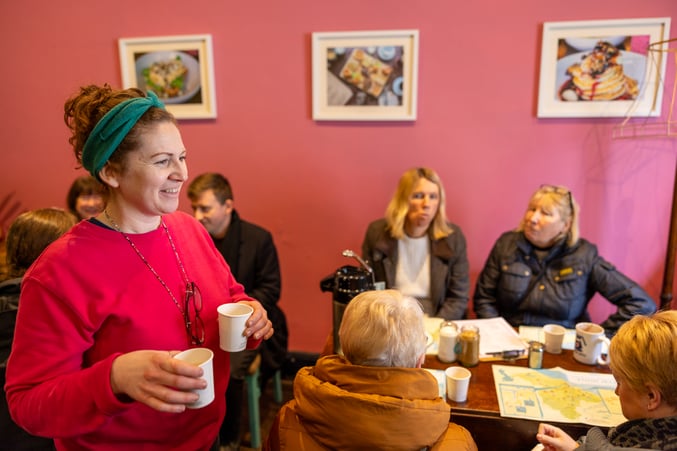
Once word got around that Riverhead was family-friendly, the “family element” grew quickly. In the early days, it started small: a few quiet toys, books, and games, plus simple, healthy options for children. Within six months, that small intention turned into something much bigger. The space expanded from a couple of tables and a tiny children’s corner to a dedicated room upstairs, with room for groups to gather. Mum-and-baby meet-ups began to happen, and Riverhead started becoming what Nic had hoped for: a place where people could build new friendships and feel less alone.
And it did not stop there.
Because Riverhead looked different and felt different, people began asking, “Do you mind if we meet up here?” “Can we run a small group?” “Could we do this?” In Nic’s words, “Everything has really sprung from what people wanted.”
That is community-led business in its truest form. Not “we know best”, but “tell us what you need and we will do our best to make space for it”.
“Like welcoming someone into my home”
Nic often says she runs Riverhead as if she is welcoming someone into her home. In practice, that is not a slogan. It is a way of paying attention to people.
For Nic, it starts with the moment someone walks through the door. A simple hello, a warm acknowledgement, a sense of recognition. She has noticed how surprised people can be by that. In a world that can feel rushed, and in a town that does not always feel welcoming to everyone, being greeted properly still matters.
Then there are the small details that turn a transaction into a relationship.
If someone forgets their loyalty card, Riverhead will write their name down and keep it behind the counter in an index box, ready for next time. It is such a small thing, but it communicates something bigger: we see you, we remember you, and you belong here.
Over time, the team get to know regulars, their usual orders, their preferences. They say goodbye. They create familiarity. And that familiarity becomes trust, which is especially important for customers with allergies or dietary requirements who need to feel safe and understood.
There is another part of Nic’s “home” approach that matters too: Riverhead is designed to feel accessible. Nic is intentional about it not being too perfect, too styled, too precious. The furniture is not perfect, and it is not meant to be. The space is meant to feel lived in, so nobody walks past and thinks, “That place is too fancy for me.”
It is a very particular kind of hospitality, the kind that says: come as you are.
A menu built through listening, not trends
Riverhead is well-known locally for its vegetarian and vegan food, and for having options that feel genuinely inclusive rather than tokenistic. But this, too, started with listening.
Nic shared a moment that captures her whole approach: a customer used to come in with her daughter. The customer was vegan, and there was never any cake she could eat, so she would buy a banana instead. Nic noticed, felt it was not good enough, and decided to do something about it.
“We’ll have to make a vegan cake,” she thought. Not because vegan was fashionable, but because someone in front of her needed it.
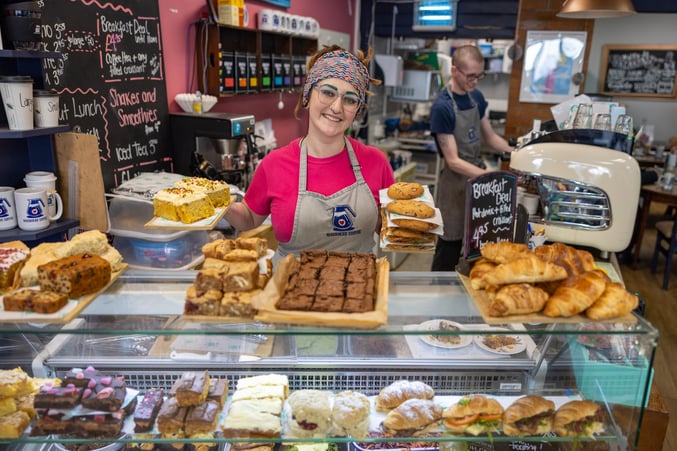
That decision opened the door. Once people saw Riverhead did things differently, they began asking for gluten-free options and other dietary needs. Nic and her team started experimenting, trying, learning, and building a menu based on what people were actually requesting.
What stands out is the commitment to quality. Nic is clear that she never wanted Riverhead to be the kind of place with one “token” vegan cake that only a vegan would tolerate. The aim is that everything tastes good, full stop.
One of their most popular cakes, the lemon and almond slice, is gluten-free, but most customers would never guess. It is simply good. And that matters, because it is a quiet form of inclusion. It means nobody feels singled out or like an afterthought. It means people can come together and enjoy the same table, the same menu, without fuss.
Nic also pointed out something important: a large proportion of Riverhead’s customers are not vegan. People come because they like the food, the atmosphere, the homemade feel, and the sense of care. They come with friends who need options, or because they simply want something delicious that feels a bit different.
That is what happens when a business chooses to serve the whole community rather than a narrow “ideal customer”.
Keeping a team in a tough industry
Hospitality is known for staff turnover, but Riverhead has kept a stable team over many years. Several staff have been with the business for four, five, six years, and one team member is heading towards nine years.
Nic puts that down to a culture where people are encouraged to be themselves. There are standards and ways of working, of course, but there is also space for individuality. People are not expected to fit a rigid mould. They can show up as they are, contribute ideas, and feel part of what Riverhead is building.
Nic also involves the team in decisions, like monthly specials and menu ideas, inviting their input and creativity. It is another version of the same principle: when people feel ownership and belonging, they are more likely to stay.
At the same time, Nic is honest about how much harder the job has become. The pressures on hospitality have increased year on year, and running the business takes more out of everyone. She shared a stark example: at one point, Riverhead might have had four staff on at lunchtime; now, they are doing it with two. That is only possible because the team work well together and have built experience, but Nic does not pretend it is easy.
“It becomes more demanding, more hard work,” she said. It is a reminder that when you step into an independent café or restaurant, you are often seeing the end result of a lot of unseen labour, problem solving, and resilience.
The hard truth about independent hospitality right now
Nic’s love for what she does is clear, but so is her frustration. And it is a frustration shared by countless independent hospitality owners across the country.
Her point is simple: hospitality should not be treated as just another “small business category”, because the pressures are distinct, intense, and have been relentless over the past five years.
She described how changes to national insurance contributions added an extra £1,000 a month in costs. Minimum wage increases are important and deserved, but they add financial pressure too, and costs ripple through the supply chain as suppliers raise prices. Utilities rose and did not come back down. Waste collection is another significant monthly cost. Business rates relief has shifted repeatedly, and in some cases reassessments have led to major increases.
Nic’s view is that the business rates system itself feels fundamentally unfair. High street businesses in town centres are charged more because of “footfall”, yet the large out-of-town operators and warehouses that dominate online shopping can face a relatively lower burden, despite having far greater scale and revenue.
Then there is VAT, which Nic described as one of the biggest issues of all. For many hospitality businesses, a large portion of what they sell attracts VAT, meaning a significant slice of every sale goes straight to government. Nic pointed out that the UK has a high VAT rate for hospitality compared with many European countries that apply reduced rates. In her view, lowering VAT for hospitality would create more breathing room for independent businesses and could encourage more people to go out and spend locally.
Underneath all of this is the part that hits hardest: even when the business takes more money year-on-year, profit can shrink dramatically because costs rise so steeply. Nic shared that Riverhead had taken more money compared to the previous year, but profit was around half. When that happens, it becomes difficult to see how the model remains sustainable, especially when business owners are working long hours and earning less than they would in a salaried job.
Most hospitality businesses, she said, are doing it for the love of it. But love does not pay the bills forever.
And the stakes are not just personal. They are about the future of towns like Grimsby.
If independent places get priced out, town centres risk becoming generic. Nic’s fear is the loss of the creative, distinctive, locally-rooted businesses that give a place its identity. That is not just bad for business owners, it is bad for community life. It is boarded-up windows. It is fewer places to gather. It is a less lively, less connected town.
The power of small choices
Nic shared something she had seen from another hospitality business that really stuck: every time we choose where to spend our money, we are “casting a vote” for the kind of place we want to live in.
That framing matters, because it turns a problem that feels too big into something we can influence.
Convenience is real, and big chains have their place. They employ local people and they are often the easiest option. But Nic invites people to pause and consider the longer-term impact of their choices, especially when it comes to supporting independent businesses that pay into the local economy and work hard to create something rooted in the community.
That does not mean everyone can always choose independent. Budgets are tight. Life is busy. But it does mean that when people can make that choice, it genuinely makes a difference.
Riverhead is proof of what independent hospitality can offer a town
There is a reason Riverhead Coffee has lasted, grown, and become such a well-loved part of Grimsby over the past decade.
It is not just the coffee, or the food, or even the aesthetic. It is that the business was built around people. It was created in response to a real need, and it has continued to evolve by listening.
It is a space where parents and children are welcome. Where you can sit alone without feeling awkward. Where your name might be remembered. Where dietary needs are treated with care, not inconvenience. Where the atmosphere is relaxed and lived-in. Where community groups have been welcomed in, not kept at arm’s length.
That is not a small thing. In a world where so much feels transactional, spaces like Riverhead help people feel connected to their town and to each other.
It is also worth noting that while much of this conversation reflects on the original Riverhead Coffee on Victoria Street in Grimsby, Nic now runs two Riverhead Coffee cafés. Alongside the Grimsby shop, there is also Riverhead Coffee on St Peter’s Avenue in Cleethorpes. When Nic talks about the values, challenges and community spirit behind Riverhead Coffee, she is describing the approach that sits behind both locations and the wider business she has built over the past decade.